
Vastu Shastra and Jyotisha: Why Timing Matters as Much as Direction
Two families build identical houses on identical plots. Both follow every Vastu rule on direction. One house feels settled and bright. The other never quite does. What went differently?
According to the old texts, the answer may lie in something most people never check: when the work began.
B. V. Raman said Vastu is a science of time and space, just as Jyotisha is a science of time, and that while the approach is scientific, the goal is always spiritual. In this article we look at how the two fit together, and why the scriptures never separate the place from the moment.
A science older than the blueprint
Tradition says eighteen sages gave us Vastu, among them Bhrigu, Atri, Vashistha, Vishvakarma and Maya. Their knowledge survives in works like the Mayamata, Vishvakarma Vastu Shastra, Samarangana Sutradhara, Mandana Sutradhara and Silparatna.
Many of these treatises read like engineering manuals. The Agamas, Tantras and Puranas read differently. For them, raising a building is not just construction. It is a sacred act, closer to a ritual than a job.
What the scriptures say
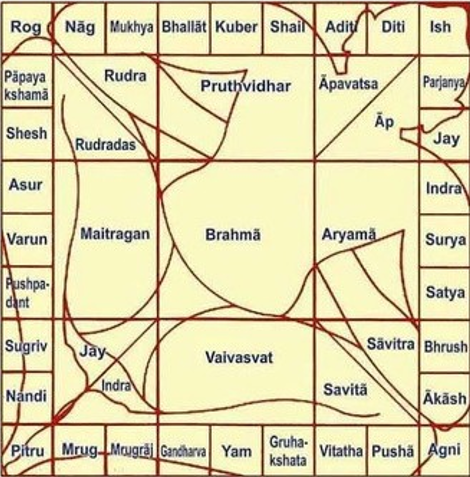
- The Agamas treat a temple as the living body of the deity, so getting the measurements right is a condition for the deity’s presence. The Kamikagama teaches how to test soil, fix true directions using a gnomon, and lay out the Vastu Purusha Mandala in grids of 64 or 81 squares. The Suprabhedagama covers temple styles and materials, and the Vaikhanasa Agama says where each subsidiary deity belongs around the sanctum.
- The Tantras bring in sacred geometry and consecration. The Hayashirsha Pancharatra links the ground plan to the form of Hayagriva, while the Kirana Tantra explains how to purify a site and appease the Vastu Purusha before a single stone is laid.
- The Puranas give us the story. The Matsya Purana says the Vastu Purusha was born from the sweat of Lord Shiva during his battle with Andhaka. He fell to the earth face down, and the gods pinned him in place, each one taking a position on his body. That is why every plot is imagined as a grid of deities. The same Purana also gives practical rules for houses, pillars, timber and town planning, and the Vishnudharmottara Purana connects architecture with sculpture, painting and music.
Space and time are not two things
Sage Vyasa said the universe can only be understood when the line between space (desha) and time (kala) is dissolved.
It sounds abstract, but the idea is practical. We think of land as something that just sits there, and of time as something that passes. The texts say otherwise. Space carries the rhythm of time through the seasons, the solstices and the movement of the planets. So a direction is never only “east” or “west.” Its character changes with the calendar, and that is why a plot cannot be judged without knowing the hour, month and planetary position at which work begins.
The Vastu Purusha who turns in his sleep
This is where Vastu gets surprising. The texts describe two forms of the Purusha:
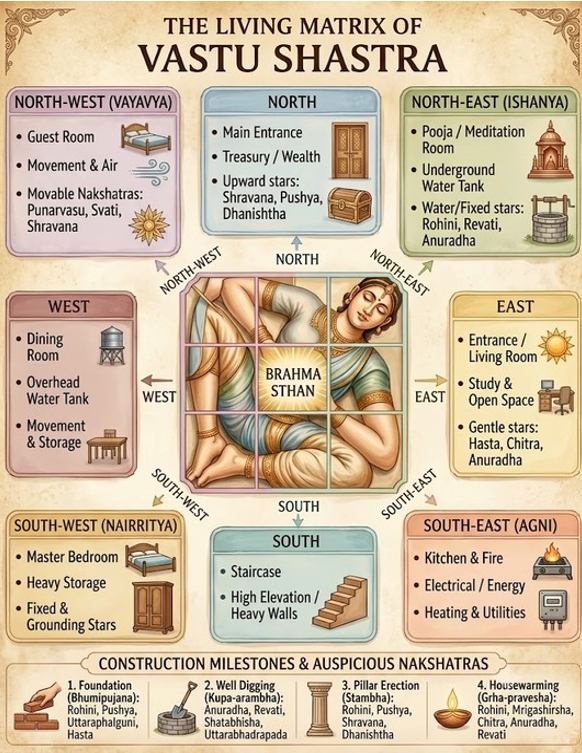
- Sthira (Nitya) Vastu, the fixed form. He lies face down with his head in the north-east (Ishana) and feet in the south-west (Nairutya). This guides the permanent zoning of rooms.
- Chara Vastu, the moving form. He is said to rest on his side and turn every three lunar months. His head points east during Bhadrapada to Karttika, south during Margashirsha to Magha, west during Phalguna to Vaishakha, and north during Jyeshtha to Shravana.
Why does it matter? Because the scriptures warn against starting work on the part of his body that is “occupied” at that time:
- On the head, it harms the master of the house.
- On the feet, it brings trouble to the wife.
- On the arms, it affects the children.
- On the back, it invites fear, instability and trouble from enemies.
- Near the navel, it brings prosperity, fertility and abundance. This is the spot to aim for.
Muhurta: choosing the right moment
The Mayamata and similar texts say that even a flawless layout can fail if work starts under unfavourable planetary conditions. They mark four key moments:
- Shilanyasa (foundation): pick a month, tithi and nakshatra that agree with the owner’s birth chart.
- Dvara sthapana (door frame): the entrance is the main channel of prana and good fortune, so it is fixed in a lagna that supports stability, usually a fixed sign.
- Well digging: water stands for wealth and peace of mind, so the Moon and Venus should be supportive.
- Griha pravesha (housewarming): the most important rite of all. Entering a new home is treated as a rebirth, and it calls for shanti karma, Vastu homa and a transit that agrees with the owner’s horoscope.
Which nakshatras suit which task
The texts match each stage of building to stars of a suitable nature:
- Foundation: Rohini, Mrigashira, Pushya, Hasta, Chitra, Anuradha, the three Uttaras and Revati. Fixed, gentle stars, because a foundation needs permanence.
- Well or water source: Rohini, Hasta, Anuradha, Magha, Pushya, Shravana, Dhanishtha, Shatabhisha, the three Uttaras and Revati.
- Pillars and roof: upward-facing, fixed stars such as Rohini, Pushya, Hasta, Anuradha, Shravana, Dhanishtha, Shatabhisha and the Uttaras. They support height and load.
- Door frame: gentle, auspicious stars such as Rohini, Mrigashira, Pushya, Hasta, Chitra, Anuradha, Jyeshtha and the Uttaras. Sharp or fierce stars are avoided.
- Housewarming: Rohini, Mrigashira, Uttara Phalguni, Chitra, Anuradha, Uttara Ashadha, Uttara Bhadrapada and Revati. These support harmony, health and children.
Treat these as general guidelines. The final date should always be checked against the owner’s own chart.
Key takeaways
- Vastu deals with space and Jyotisha deals with time, and the scriptures treat them as one continuum.
- The Agamas, Tantras and Puranas see construction as a sacred act, not only a technical one.
- Chara Vastu means the Vastu Purusha turns every three lunar months, so the same plot can be right or wrong to start on depending on the season.
- Foundation, door frame, well and housewarming each have their own muhurta and their own suitable nakshatras.
- Timing should always be matched with the owner’s birth chart.
Frequently asked questions
What is the connection between Vastu Shastra and Jyotisha?
Vastu looks at space and direction, while Jyotisha looks at time. The scriptures say the two cannot be separated, so a good plan also needs a good date to begin.
What is Chara Vastu?
It is the moving form of the Vastu Purusha, who is said to turn every three lunar months. It tells you which part of his body lies over which direction during each season.
Which part of the Vastu Purusha should be avoided when laying a foundation?
The head, feet, arms and back are advised against, and the navel is considered the best spot.
Why is the housewarming muhurta so important?
Griha pravesha is treated as the rebirth of the home. It calls for shanti karma, Vastu homa and a transit that agrees with the owner’s horoscope.
Can I pick a nakshatra from this list and start building?
The list is a general guide from the texts. The final date should be fixed after checking your own birth chart.
Conclusion
A home is more than walls and a roof. In the Indian tradition it is a living structure in harmony with the cosmos, where Vastu gives it the right place and Jyotisha gives it the right moment. When the two agree, every door, pillar and room is believed to carry life-nourishing energy.
So before you break ground, buy a plot or step into a new home, ask the second question too. Not only “where?” but also “when?”
Plan your home with the right guidance
If you are planning to build, buy or move into a new home, our team can help you choose the right muhurta and direction for your birth chart. Book a consultation with Saptarishis Astrology and begin on the right note.








Add comment
You must be logged in to post a comment.